Posts

Showing posts with the label air pollutants

Air Pollution: Environmental Pollutant Linked To Mental Diseases

Image
Air pollution has become a major global health challenge. Studies have placed deaths resulting from air pollution above that caused by malaria and HIV/AIDS put together . Although air pollutants have been linked with lung and heart diseases, there are new evidences that air pollution may be associated with degenerative brain diseases like cognitive disorder, mental illness and Alzheimer's disease.

Air Pollution: Environmental Pollutant Linked To Neural Tube Defects

Image
Benzene is a colorless , flammable liquid with a sweet odor. It evaporates quickly when exposed to air. Benzene is formed from natural processes, such as volcanoes and forest fires, but most exposure to benzene results from human activities. The most important source of exposure to  benzene is mainstream smoke from cigarettes , which accounts for about 50% of population burden of exposure. It is also used mainly as a starting material in making other chemicals, including plastics, lubricants, rubbers, dyes, detergents, drugs, and pesticides. In the past it was also commonly used as an industrial solvent (a substance that can dissolve or extract other substances) and as a gasoline additive, but these uses have been greatly reduced in recent decades . Environmental tobacco smoke or secondhand smoke is an important source, accounting for about 5% of total nationwide exposure.

Heavy Traffic And Air Pollution Linked To Dementia

Image
A recent study in the Ontario environment has raised general health worries about the effect of air pollution and traffic . T he study also found out that individuals who lived within 50 meters of a heavy traffic environment had a 7% higher risk of dementia when co mpared with individuals who lived more than 300 meters far from  such environment .

Health Effects Of Environmental Exposure To Aluminum Pollution

Image
Aluminum has been for quite some time known to be neurotoxic, with mounting proof that its long term environmental exposure is a linked to numerous neurological diseases, including dementia, a mental imbalance, and Parkinson's disease. Nonetheless, research validation is hard to establish due to the absence of longitudinal studies, as well as push back from industries that use aluminum in their products. Regardless of the deficiency of conclusive reviews, mounting scientific proof practically rules out the uncertainty of its toxicity. A valid example is scientific investigation from Keele University in the UK which unequivocally indicates large amounts of aluminum in the brain of an individual exposed to aluminum at work, who later died from Alzheimer's disease. While aluminum exposure has been involved in Alzheimer's and various other neurological diseases, this case happens to be "the main direct connection" between Alzheimer's disease and elevated...

Malnutrition Linked To Air Pollution and Ozone Depletion

Image
The world will require 50 percent more nourishment by 2050 because of both an expanding populace and a move toward a more Westernized eating routine in creating nations. In any case, as our requirement for nourishment rises, our capacity to deliver that sustenance might be brought down by atmosphere and air quality changes, concurring a to a review simply distributed in Nature Climate Change. Environmental scientists from MIT and Colorado State University found that if everything else remains as it is today, by 2050 global warming may lessen world harvest yields by around 10 percent. Be that as it may, world harvest yields confront a greater number of difficulties than simply rising temperatures. Ozone pollution likewise harms crops , while being harder to evaluate. A few products are harmed most by outrageous temperature swings, others more by ozone. "Ozone pollution can likewise be dubious to recognize since its harm can look like other plant diseases, creating bits on ...

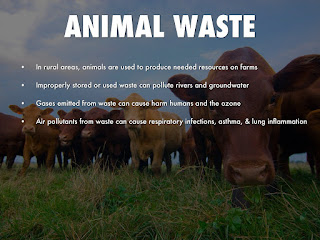
Air And Water Pollution: Impact Of Animal Farming on The Environment

Image
Environmental impact of animal production : "Each one of us has an impact on the environment and the world in which we live. Growing food and raising animals also uses resources from the earth. Humans impact the environment through deforestation, agricultural and livestock activities, urbanization and burning fossil fuels. Each and every living creature produces greenhouse gases (GHG). Greenhouse gases are gases in the earth’s atmosphere and can be produced in nature and through human industry. An increased amount of GHG generates high temperatures on earth. The most abundant GHG are water vapor, carbon dioxide, methane, nitrous oxide and ozone. The amount of GHG that agriculture and farming produces around the world is different. This is because each livestock production system is different in the way it uses resources. Agricultural systems are often categorized into two types of systems: extensive farming and intensive farming.

Air Pollution, Environmental Pollutants And Your Child's Health

Image
Children and Air Pollution | : Children breathe more air per pound of body weight, so their exposure to air pollution is much greater than adults.  Children’s organs, including their lungs, develop until they reach their late teens, usually around the age of 18.  Studies show that developing organs are sensitive to the toxic effects of air pollutants and environmental toxins, and that children absorb pollutants more readily than adults and retain them in the body for longer periods of time.*  According to the World Resources Institute, “Because they breathe at a higher rate than adults, children are exposed to greater levels of pollution relative to their smaller body weight and are generally more sensitive to their effects on a pound-for-pound basis.”

Air Pollution Linked With Eye Infections

Image
What Air Pollution Does to Eyes and Vision : " Air pollution , no doubt, has had numerous health impacts on humans, but when it comes to air pollution in relation to eyes and vision, there seems to be a gap. This phenomenon has not been studied in depth in the way that perhaps pollution in relation to our pulmonary system has, but there is evidence to suggest that pollution is hurting our eyes. Our eyes are incredibly exposed and sensitive. If you’ve ever had the misfortune of getting dust or sand in your eyes (which everyone is likely to have experienced at least once), then you know the irritation and discomfort involved. Though pollution is a little sneakier than dust and sand, it can have an equal or worse effect on our eyes in the long run.

Air Pollutants Linked To Higher Risk Of Birth Defect

Image
Air pollutants linked to higher risk of birth defects, researchers find | News Center | Stanford Medicine : "Breathing traffic pollution in early pregnancy is linked to a higher risk for certain serious birth defects, according to new research from the Stanford University School of Medicine. The finding comes from a study examining air quality and birth-defect data for women living in California’s San Joaquin Valley, one of the smoggiest regions of the country. “We found an association between specific traffic-related air pollutants and neural tube defects, which are malformations of the brain and spine,” said the study’s lead author, Amy Padula, PhD, a postdoctoral scholar in pediatrics. The research appears online today in the American Journal of Epidemiology.